
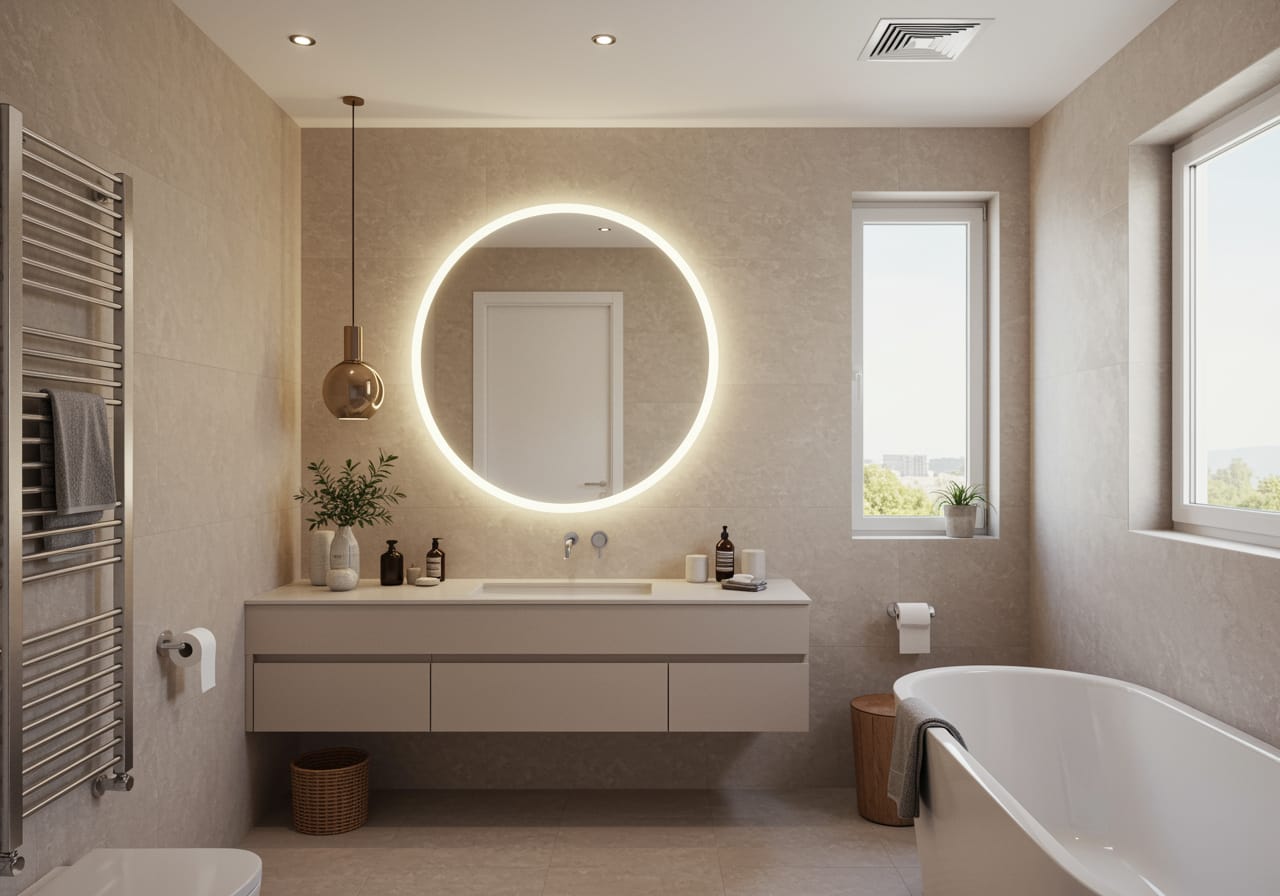
LED Bathroom Mirror Styles: Which Type Fits Your Vanity Layout
Not every illuminated mirror lights a bathroom the same way. Some cast a soft halo around the frame, others shine forward through the glass itself, and a few use a thin strip along the edges to blend the two approaches. An led bathroom mirror can transform a vanity wall, but picking the wrong style for the room’s layout is a common reason people end up unhappy with an otherwise well-made mirror. Understanding the different lighting styles, and how they interact with a vanity’s size and shape, makes the choice a lot more predictable.
Backlit, Frontlit, and Edge-Lit: What’s the Difference
The three most common lighting styles distribute light differently, and each suits a different kind of bathroom.
- Backlit mirrors place LEDs behind the glass, creating a soft glow around the mirror’s perimeter that works well as ambient lighting but isn’t strong enough on its own for detailed grooming tasks
- Frontlit mirrors shine light forward through a translucent panel or diffuser, producing more direct, even illumination across the face, which tends to suit anyone doing makeup or shaving in front of it
- Edge-lit mirrors run a thin LED strip along the mirror’s border, offering a middle ground between the ambient glow of a backlit design and the brighter, more functional output of a frontlit one
- Combination models pair a frontlit center panel with a backlit halo, giving both a soft accent glow and stronger task lighting from the same fixture
Matching the Mirror to a Single or Double Vanity
Vanity width and layout affect which mirror size and lighting style actually reads well once installed.
- A single vanity typically pairs with one mirror sized close to the width of the sink and countertop below it, leaving a few inches of margin on either side
- A double vanity generally looks best with either two matching mirrors centered over each sink, or one wide mirror spanning both, depending on how much wall space sits between the fixtures
- Backlit and edge-lit styles tend to look more cohesive across a double vanity, since the ambient glow reads as one continuous design element rather than two separate light sources competing for attention
- Frontlit mirrors work well individually over each sink in a double vanity, since the brighter, more direct light benefits each person’s routine independently
Portrait vs. Landscape Orientation
Mirror orientation affects both how much wall space it uses and how the light itself falls across a person’s face or body.
A portrait-oriented mirror tends to suit narrower vanities or powder rooms where wall width is limited, and it also allows the light to run the full height of the mirror, which is useful for checking an outfit or full hair length rather than just the face. Landscape orientation suits wider vanities better, especially double sinks, and spreads light horizontally across a broader field of view. Some frames work in either orientation depending on mounting hardware, so it’s worth checking whether a specific model is designed for one orientation only before assuming it can be rotated.
Coordinating With Existing Bathroom Lighting
An LED mirror rarely operates in isolation, and how it interacts with the room’s other light sources affects the final result more than the mirror’s specs alone.
- If the bathroom already has strong overhead lighting, a backlit mirror’s ambient glow may barely register, making a frontlit or edge-lit option a better fit for adding noticeable task light
- In bathrooms with dim or minimal overhead lighting, a bright frontlit mirror can end up feeling harsh without a dimmer to bring the output down for evening use
- Warm-toned overhead bulbs paired with a cool-toned LED mirror can create a mismatched color cast across the room, so checking color temperature compatibility avoids a two-tone lighting effect
- A dimmable mirror offers the most flexibility for coordinating with whatever else is already installed, since the brightness can be adjusted rather than replaced
What to Confirm Before Ordering
A few practical checks prevent the most common issues that show up after a mirror arrives and gets mounted.
- Confirm the mirror’s width and height against the actual vanity and wall space, not just a general size category
- Verify there’s an accessible power source at the mounting location, or budget for an electrician if one needs to be added
- Check whether the mirror includes a built-in dimmer or requires a compatible wall switch
- Ask about adjustable color temperature if the mirror needs to work well both in daylight and in the evening
- Confirm mounting hardware is rated for the mirror’s weight, particularly for larger backlit or combination models
Choosing the right led bathroom mirror comes down to matching the lighting style, orientation, and brightness to how the space is already used, rather than picking the most striking option in a showroom. Backlit, frontlit, and edge-lit designs each solve a slightly different problem, and getting that match right matters more than any single spec. Retailers such as Allsumhome list lighting style, dimensions, and dimmer compatibility on each product page, which makes comparing options across a vanity layout much easier before ordering.
