
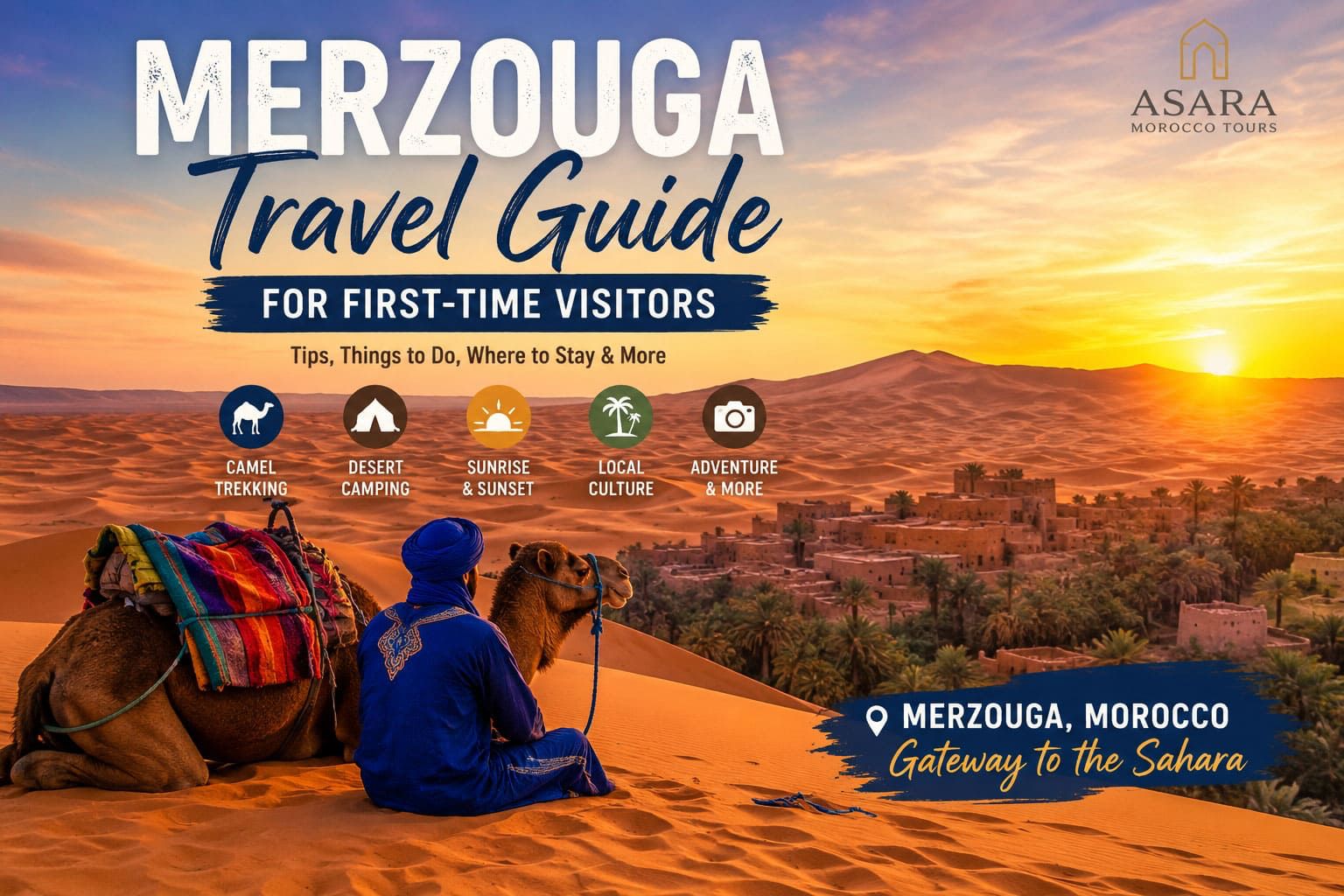
A first-hand, locally written guide to Morocco’s most magical desert — by the team at Asara Morocco Tours, Marrakech.
Imagine standing at the edge of a sea of golden sand, watching the first light of dawn turn the towering dunes of Erg Chebbi from deep amber to soft rose. A camel waits patiently beside you, a glass of sweet mint tea cools in your hand, and the only sound is the wind shaping the Sahara. This is Merzouga — and if you’re planning your first trip to Morocco, it deserves a place at the very top of your list. This Merzouga travel guide brings together everything we’ve learned guiding travelers across the dunes since 2014, so you can arrive prepared, confident, and ready for the trip of a lifetime.
At Asara Morocco Tours, we’re a Berber-owned, Marrakech-based team who grew up with the desert in our blood. We’ve written this guide the way we’d brief a close friend visiting Merzouga for the very first time — honest, practical, and full of the small details that make a big difference.
1. Where is Merzouga?
Merzouga is a small Berber village in southeastern Morocco, sitting right on the doorstep of the Sahara Desert in the Draa-Tafilalet region. It lies close to the Algerian border, roughly 35 kilometres south of the town of Rissani and about 50 kilometres from Erfoud. What makes it world-famous is its neighbour: Erg Chebbi, a breathtaking sea of wind-sculpted dunes that rise up to 150 metres — some of the tallest and most photogenic sand formations in all of Morocco.
For first-time visitors, the geography is simple to picture. Most travelers reach Merzouga overland from Marrakech Desert Tours in the west or from Fes in the north. Either route crosses the High Atlas Mountains and the pre-Saharan plains before the landscape suddenly opens into open desert. The village itself is modest — a cluster of guesthouses, kasbahs, and shops — but it serves as the launchpad for the real attraction: a night under the stars in the dunes.
| ✔ Local Insight
Locals often use “Merzouga” and “Erg Chebbi” interchangeably, but they’re not quite the same. Merzouga is the village where your tour vehicle stops; Erg Chebbi is the dune field where the magic happens. Your camp will almost always be inside the dunes, a short camel ride or 4×4 hop beyond the village edge. |
2. Why Visit Merzouga?
Morocco has more than one patch of desert, so why does Merzouga earn such devotion from travelers? The honest answer is that it delivers the Sahara of your imagination — vast, cinematic, and surprisingly accessible. Here’s what sets it apart:
- Iconic dunes: Erg Chebbi’s towering, ever-shifting sand mountains are the postcard image of the Moroccan Sahara, glowing orange at sunrise and deep gold at dusk.
- Authentic culture: This is Berber and nomad heartland. You’ll meet families whose ancestors have crossed these sands for centuries, and hear soulful Gnawa music around the fire.
- Unforgettable nights: Sleeping in a desert camp under one of the clearest, most star-filled skies on Earth is a memory most travelers rank as the highlight of their entire Morocco trip.
- Adventure on tap: Camel trekking, sandboarding, 4×4 excursions, and quad biking are all on offer within a short distance of the village.
- Genuine accessibility: Unlike many great deserts, Merzouga can be reached comfortably by road, making it ideal for a first Moroccan desert experience.
If you’re weighing Merzouga against the closer dunes of Zagora, the difference is dramatic. Zagora’s small, rocky dunes work for a quick overnight, but Merzouga’s Erg Chebbi offers the full, soul-stirring Sahara. For most first-timers chasing that bucket-list moment, the extra travel time is more than worth it. Our 3 Days Desert Tour from Marrakech to Merzouga is the route we recommend most often for exactly this reason.
3. Best Time to Visit Merzouga
The Sahara is a land of extremes, so timing your trip well makes a real difference to your comfort. In short, the best time to visit Merzouga is during the shoulder seasons of spring and autumn, when daytime temperatures are warm but not punishing and the nights are cool and clear.
Season-by-Season Overview
| Season | Months | Weather | Best For |
|---|---|---|---|
| Spring | Mar–May | Warm days (22–30°C), mild nights | The ideal window — comfortable trekking and clear skies |
| Autumn | Sep–Nov | Warm, settling cooler (24–32°C) | Excellent light, fewer crowds, pleasant camps |
| Winter | Dec–Feb | Cool days (15–20°C), cold nights (near 0°C) | Crisp blue skies, dramatic dunes, bring warm layers |
| Summer | Jun–Aug | Very hot (38–48°C) | Only for the heat-tolerant; activities shift to dawn and dusk |
| ✔ Travel Tip
Aim for late March to May or late September to November for the sweet spot. You’ll get warm, sunny days for camel trekking and cool, comfortable nights perfect for stargazing — without the searing summer heat or the deepest winter chill. |
Whatever month you choose, remember the golden rule of the desert: days can be hot and nights surprisingly cold, sometimes within the same 24 hours. We cover exactly what to pack for this further down the guide.
4. How to Get to Merzouga
Merzouga has no airport and no train station, which is part of what keeps it feeling remote and authentic. Reaching it is a journey — and a beautiful one. There are four realistic ways to arrive, each suited to a different kind of traveler.
Your Main Options
- Private organized tour (most popular): A driver-guide collects you from Marrakech or Fes and handles everything — route, stops, camp, and timing. The most comfortable and stress-free choice for first-timers.
- Shared group tour: A budget-friendly minibus option with a fixed itinerary and other travelers. Cheaper, but less flexible.
- Self-drive: Renting a car gives freedom but means long hours on mountain roads, navigation, and arranging your own camp.
- Public bus (Supratours / CTM): Long-distance buses run to Rissani or Merzouga from major cities. Inexpensive but slow, with limited departures.
Most travelers reach Merzouga from one of two gateway cities:
| From | Distance | Driving Time | Notes |
|---|---|---|---|
| Marrakech | ~560 km | 8–9 hours | Crosses the High Atlas via Tizi n’Tichka pass — stunning scenery |
| Fes | ~470 km | 7–8 hours | Passes Ifrane, cedar forests, and the Ziz Valley |
| Ouarzazate | ~360 km | 5–6 hours | A common mid-route stop on Marrakech tours |
| Errachidia | ~120 km | 1.5–2 hours | Nearest small regional airport (limited flights) |
Because the drive is long and the scenery is a huge part of the experience, we strongly suggest breaking the journey rather than rushing it. That’s exactly how our 4 Days Tour from Marrakech to Merzouga is designed — with unhurried stops at Ait Ben Haddou, the Dades or Todra gorges, and the palm-lined valleys along the way.
5. Best Desert Tours to Reach Merzouga
For a first visit, a guided desert tour is the easiest, safest, and often most rewarding way to experience Merzouga. You skip the logistics, travel with someone who knows the roads and the people, and arrive at a camp that’s already arranged. Here are the routes we run most often:
Popular Routes from Marrakech & Fes
- 3 Days from Marrakech to Merzouga (round trip): The classic Sahara escape — over the Atlas, into the dunes for a night, and back. Perfect when time is tight.
- 4 Days from Marrakech to Merzouga: A more relaxed version with extra time in the gorges and valleys, ideal if you want to savour the journey.
- 3 Days Marrakech to Fes via Merzouga: A one-way crossing of Morocco that ends in Fes — superb if you’re continuing north afterwards.
If your itinerary runs between Morocco’s two great imperial cities, the 3 Days Marrakech to Fes Desert Tour is wonderfully efficient: you experience the Sahara without backtracking. Travelers heading the other direction can take the same route as a desert tour from Marrakech to Fes, finishing in the medieval heart of Fes. And if you want the deepest immersion of all, our extended desert tour from Marrakech gives you the time the desert truly deserves.
| ✔ Travel Tip
Book your desert tour before you fly to Morocco, especially for spring and autumn travel. The best camps and the most experienced guides fill up quickly in peak season, and locking in early means a smoother, better-value trip. |
6. Top Things to Do in Merzouga
Merzouga is small, but the experiences packed around it are anything but. Here’s a quick overview of the highlights before we explore the big ones in detail:
- Camel trekking across Erg Chebbi — the timeless way to enter the dunes
- Overnight in a desert camp — from comfortable to genuinely luxurious
- Sunrise and sunset over the dunes — the photographic heart of any visit
- Sandboarding down the slopes of Erg Chebbi
- 4×4 desert excursions to nomad camps, fossils, and the old mines of Khamlia
- Gnawa music evenings with the descendants of Saharan musicians in Khamlia village
- Visiting Lake Dayet Srji, a seasonal lake that draws flamingos in spring
Let’s look at the experiences that first-time visitors remember most.
7. Experience Camel Trekking
No image captures the Sahara quite like a line of camels crossing the dunes at golden hour — and in Merzouga, you don’t just watch it, you live it. Camel trekking in Merzouga is the traditional, almost ceremonial way to travel from the village edge into the heart of Erg Chebbi, usually as the sun begins to set.
A typical trek lasts around 60 to 90 minutes each way. Your camel — technically a dromedary — is led by an experienced local cameleer who knows every ridge of the dunes. The gentle, rolling rhythm takes a few minutes to get used to, then becomes oddly soothing as the light softens around you.
What to Expect on a Camel Trek
- Treks are slow and steady — suitable for most ages and fitness levels
- You’ll mount and dismount while the camel kneels; hold on firmly as it rises
- Wear long trousers to avoid chafing, and bring a scarf for sun and sand
- The sunset trek into camp is the most popular, with a sunrise return the next morning
| ✔ Safety Tip
Listen to your cameleer when mounting and dismounting — the camel rises back legs first, so lean back, then forward. Keep both hands on the saddle frame. Children should always ride with or directly beside an adult and a guide. |
| ✔ Local Insight
A good operator looks after the animals as well as the guests. At Asara Morocco Tours we work with cameleers who rest, water, and rotate their camels properly — a tired or mistreated camel is never part of an authentic, responsible desert experience. |
8. Spend a Night in a Luxury Desert Camp
Sleeping in the dunes is the centrepiece of any Merzouga trip, and the standard of desert camps has risen dramatically in recent years. Today you can choose anything from a simple, traditional bivouac to a genuinely luxurious camp with private bathrooms, proper beds, and candlelit dinners under the stars.
Luxury Camp vs Standard Camp
| Feature | Luxury Desert Camp | Standard Desert Camp |
|---|---|---|
| Tents | Spacious, furnished, en-suite | Simple, shared facilities |
| Beds | Real beds, quality linens | Mattresses with blankets |
| Bathroom | Private flushing toilet & hot shower | Shared basic facilities |
| Dining | Multi-course Moroccan dinner, served | Hearty traditional tagine |
| Atmosphere | Rugs, lanterns, lounge area, fire | Campfire and music |
| Best for | Couples, families, comfort-seekers | Budget travelers, backpackers |
| Price guide | Higher | Lower |
Both options share the same priceless features: the silence of the desert, the campfire, the Berber drumming, and a canopy of stars overhead. The choice comes down to how much comfort you want wrapped around that experience.
| ✔ Travel Tip
If this is a special trip — a honeymoon, an anniversary, or simply a once-in-a-lifetime Morocco adventure — the upgrade to a luxury camp is one of the best-value splurges in the country. The difference in comfort is large; the difference in price is often modest. |
9. Explore Erg Chebbi Dunes
Erg Chebbi is the reason most people come to Merzouga. This great erg — an Arabic word for a sea of dunes — stretches roughly 28 kilometres north to south and up to 7 kilometres wide, with crests reaching around 150 metres. The sand glows in shifting shades of pink, orange, and gold as the sun moves across the sky, and the dunes are constantly resculpted by the wind, so no two visits ever look the same.
Exploring the dunes is wonderfully simple. You can climb a high ridge on foot for panoramic views, ride across them by camel, race over them in a 4×4, or simply sit in the sand and watch the light change. The highest dunes are a stiff but rewarding walk — sand is hard work underfoot, so take your time.
| ✔ Photographer’s Tip
The best light falls in the first hour after sunrise and the last hour before sunset, when low-angle sun rakes across the dunes and carves out their ripples and shadows. Shoot with the sun to your side, not behind you, to capture texture — and protect your camera from fine sand with a sealed bag between shots. |
Erg Chebbi is also steeped in local legend and ecological interest. Seasonal rains occasionally fill nearby Lake Dayet Srji, attracting pink flamingos in spring, while the surrounding hammada (stony desert) hides fossils that tell of an ancient seabed beneath this now-arid land.
10. Meet Local Berber Communities
Merzouga isn’t an empty wilderness — it’s home. The region is part of the Berber (Amazigh) world, with deep nomadic traditions, and the chance to meet local people respectfully is one of the most enriching parts of a visit.
A short drive from Merzouga lies the village of Khamlia, famous for its Gnawa community — descendants of sub-Saharan peoples whose hypnotic music blends African rhythms with spiritual song. A visit here, with a cup of tea and a live performance, is a window into a culture you won’t find in guidebooks alone.
- Meet nomadic families who still live in tents and herd animals across the desert
- Hear Gnawa music performed live in Khamlia
- Learn how Berber rugs, bread, and tea are made the traditional way
- Understand desert survival skills passed down across generations
| ✔ Local Insight
When you’re invited for tea, accept warmly — hospitality is sacred in the Sahara. Always ask before photographing people, dress modestly out of respect, and consider buying directly from local artisans. Travel that supports these communities helps keep their way of life alive. |
11. Try Traditional Moroccan Cuisine
Desert hospitality is delicious. Out in the camps and villages around Merzouga, food is simple, slow-cooked, and deeply satisfying — a comforting end to a day in the dunes. Expect generous portions and a warm welcome at every meal.
Dishes to Try Around Merzouga
- Tagine: slow-cooked stew of meat or vegetables with aromatic spices, served in its cone-shaped clay pot
- Berber pizza (Madfouna): a stuffed, baked bread filled with meat, onions, and spices — a Sahara speciality
- Couscous: the traditional Friday dish, fluffy semolina topped with tender vegetables and meat
- Harira: a hearty tomato and lentil soup, especially welcome on cool desert nights
- Moroccan mint tea: sweet, refreshing, and poured from a height — the drink of welcome everywhere
| ✔ Travel Tip
Tell your tour operator in advance about any dietary needs — vegetarian, vegan, gluten-free, or allergies. Desert kitchens are wonderfully accommodating with notice, and most tagines and couscous dishes can easily be made meat-free. |
12. Watch Sunrise & Sunset in the Sahara
If you remember one thing from this Merzouga travel guide, let it be this: do not miss the light. Sunrise and sunset over Erg Chebbi are the experiences travelers describe long after they’ve gone home.
At sunset, the dunes blaze orange and the desert falls silent as the day cools. At sunrise, the sand glows soft pink and gold while the air is still and fresh — worth every minute of the early start. Most overnight tours are timed so you ride in for sunset and wake for sunrise, capturing both the easy way.
- Sunset: climb a nearby dune with your tea and watch the colours deepen
- Stargazing: after dark, the Milky Way appears with astonishing clarity — no light pollution for miles
- Sunrise: wake before dawn, climb the ridge above camp, and watch the desert reawaken
| ✔ Photographer’s Tip
For star photos, bring a small tripod and use a 15–25 second exposure at a wide aperture. For sunrise, scout your dune the evening before so you’re in position before the light arrives — the best colours last only a few fleeting minutes. |
13. Adventure Activities in Merzouga
Beyond camel trekking, Merzouga offers a genuine playground of desert adventures. Whether you want an adrenaline rush or a gentle explore, there’s something to suit every traveler:
- Sandboarding: strap on a board and slide down the dunes of Erg Chebbi — boards are easy to rent locally
- Quad biking & ATV tours: zip across the desert flats and dune edges on a guided ride
- 4×4 desert excursions: explore nomad camps, fossil sites, the Gnawa village of Khamlia, and old mining areas
- Dune hiking: a free, rewarding workout to the highest ridges for panoramic views
- Birdwatching: seasonal Lake Dayet Srji attracts flamingos and migratory birds in spring
| ✔ Safety Tip
For quad biking and sandboarding, always use a reputable operator who provides safety briefings and, for quads, helmets. The desert sun is deceptively strong during active sports — carry water and sunscreen even for a short outing. |
14. Where to Stay in Merzouga
Deciding where to stay in Merzouga comes down to two questions: do you want to sleep in the village or out in the dunes, and how much comfort do you want? Here’s how the options break down.
Your Accommodation Choices
- Desert camps (in the dunes): the signature experience — sleep among the sands of Erg Chebbi, from standard bivouacs to luxury camps
- Kasbahs & guesthouses (village edge): traditional mud-brick lodgings with pools and dune views, ideal for a comfortable base
- Boutique hotels: a handful of stylish, higher-end stays for travelers who want extra polish
For first-timers, the ideal combination is one night in a desert camp for the full Sahara experience, with the rest of your stay (if longer) at a comfortable kasbah on the village edge. A well-planned tour arranges all of this seamlessly so you never have to worry about logistics.
| ✔ Travel Tip
When booking a camp, check exactly what’s included: private vs shared bathrooms, dinner and breakfast, the camel trek, and transfers. Reputable operators are completely transparent about this — if the details are vague, ask before you commit. |
15. What to Pack for Merzouga
The desert rewards the well-prepared. Because Merzouga can be hot by day and cold by night, packing smart layers is the single best thing you can do for your comfort. Here’s our field-tested checklist.
Essentials Checklist
- Light, breathable, modest clothing for daytime (long sleeves protect from sun)
- A warm fleece or jacket for cold desert nights — yes, even in summer at altitude
- A scarf or shaal (chèche) to shield against sun, wind, and blowing sand
- Comfortable closed shoes plus sandals for the sand
- Sunglasses, high-SPF sunscreen, and a wide-brimmed hat
- Reusable water bottle and any personal medications
- Power bank, headlamp or torch, and a small daypack
- Wet wipes and hand sanitiser for desert convenience
| ✔ Packing Tip
Pack a small bag with just your overnight desert essentials — you won’t want to haul a full suitcase onto a camel. Leave your main luggage at the kasbah or in the vehicle, and take only what you need for the night in the dunes. |
16. Practical Travel Tips
A few practical pointers will make your first Merzouga trip smoother and more rewarding:
- Money: carry enough cash in Moroccan dirham — ATMs are limited near Merzouga, and most camps and small shops are cash-based.
- Connectivity: a local SIM card gives decent signal in the village; expect patchy or no coverage deep in the dunes (embrace the digital detox).
- Language: Berber and Arabic are spoken locally; French is common, and most guides speak good English.
- Health: drink bottled or purified water, and pace yourself in the heat — hydration is everything.
- Respect: dress modestly, ask before photographing people, and follow your guide’s lead on local customs.
- Leave no trace: take all rubbish with you and tread lightly — the desert ecosystem is fragile.
| ✔ Local Insight
Responsible desert travel keeps Merzouga special. Choose operators who employ local people, look after their camels, manage waste properly, and respect the communities you visit. Tourism done well is a lifeline for this region — done badly, it erodes the very thing you came to see. |
17. Sample 3-Day Merzouga Itinerary
To show how it all fits together, here’s a sample Merzouga itinerary based on our most popular route from Marrakech. It’s a guideline — a private tour can be flexed entirely to your pace.
Day 1 — Marrakech to the Dades or Todra Valley
- Cross the High Atlas via the dramatic Tizi n’Tichka pass
- Visit the UNESCO-listed kasbah of Ait Ben Haddou
- Continue through Ouarzazate to the rose-coloured Dades or Todra gorges for the night
Day 2 — Gorges to Merzouga & the Dunes
- Drive through palm valleys to Erfoud and Rissani
- Arrive at Merzouga and meet your camels by mid-afternoon
- Sunset camel trek into Erg Chebbi, dinner and Berber music at your desert camp under the stars
Day 3 — Sahara Sunrise & Return
- Wake for sunrise over the dunes
- Camel trek back, breakfast at the kasbah, then begin the return journey
- Drive back to Marrakech — or continue to Fes on the one-way route
Prefer to slow things down? An extra day turns this into our 4-Day Morocco Desert Tour, with more time in the gorges and valleys. Travelers crossing the country can follow the same plan as a Marrakech to Merzouga itinerary that loops back, or as a Marrakech to Fes via Merzouga one-way crossing.
Private Tour vs Shared Tour: Which Is Right for You?
One of the biggest decisions first-time visitors face is whether to book a private tour or join a shared group. Both reach the same dunes, but the experience differs significantly.
| Factor | Private Tour | Shared Group Tour |
|---|---|---|
| Flexibility | Fully customizable pace & stops | Fixed schedule, set stops |
| Group size | Just your party | Up to ~16 travelers |
| Comfort | Private vehicle, your choices | Shared minibus |
| Personal attention | Dedicated driver-guide | Shared guide |
| Pace | Stop whenever you like | Limited stops |
| Price | Higher per person | Budget-friendly |
| Best for | Families, couples, first-timers | Solo & budget travelers |
For most first-time visitors — especially couples and families — a private tour is well worth it. You travel at your own rhythm, stop for the photos you want, and have a guide focused entirely on your experience. This is the style Asara Morocco Tours specializes in.
Transportation Options to Merzouga at a Glance
| Option | Comfort | Cost | Best For |
|---|---|---|---|
| Private tour | Highest | $$$ | First-timers wanting ease & flexibility |
| Shared tour | Medium | $$ | Budget travelers, solo adventurers |
| Self-drive | Medium | $$ | Confident drivers wanting freedom |
| Public bus | Lower | $ | Backpackers with time to spare |
Explore Merzouga with Asara Morocco Tours
After guiding travelers across these dunes since 2014, we’ve built our tours around one idea: the Sahara should feel personal, authentic, and effortless. As a Berber-owned, Marrakech-based operator, we know this land because it’s home. Here’s why first-time visitors choose us:
- Private, tailor-made tours: your itinerary is built around your pace, interests, and travel dates — never a rigid template.
- English-speaking local drivers: knowledgeable Berber driver-guides who share the stories, history, and hidden corners of the route.
- Comfortable transportation: modern, air-conditioned vehicles for the long and beautiful desert roads.
- Authentic desert camps: from comfortable to luxury, all chosen for genuine quality and responsible standards.
- Flexible itineraries: stop for photos, tea, or a longer wander whenever the moment calls for it.
- Local expertise: we work hand-in-hand with the communities you’ll meet, supporting them directly.
- Personalized service: real human help from first enquiry to the moment you head home.
- Transparent pricing: clear, honest quotes with no hidden surprises.
Our track record speaks for itself: more than 900 tours completed since 2014, and a 5.0-star rating from 82+ Tripadvisor reviews. We’d love to make your first Merzouga trip just as memorable.
| ✔ Ready to See the Sahara?
Let’s plan your private Merzouga desert adventure together. WhatsApp: +212 718 785 883 Email: [email protected] Office: Bloc 2 N53, Hay Hassani, Menara, Marrakech Browse our full range of Desert Tours from Marrakech and message us to start planning. |
18. Frequently Asked Questions
Is Merzouga worth visiting?
Absolutely. Merzouga offers Morocco’s most spectacular dunes at Erg Chebbi, authentic Berber culture, unforgettable desert camps, and some of the clearest night skies on Earth. For most first-time visitors, the night in the Sahara is the single highlight of their entire Morocco trip.
How many days should I spend in Merzouga?
Plan for at least one overnight in the desert. A 3-day tour from Marrakech or Fes is the most popular choice, while a 4-day tour adds a more relaxed pace and extra time in the gorges and valleys. Even one night in the dunes delivers the full experience.
Can you visit Merzouga without a tour?
Yes, you can reach Merzouga by self-drive or public bus and arrange a camp independently. However, a guided tour handles the long drive, logistics, and camp arrangements for you — which is why most first-time visitors find it far easier and more rewarding.
Is Merzouga safe?
Merzouga is considered very safe for tourists, including families and solo travelers. The main things to manage are the heat, sun, and hydration. Traveling with a reputable local operator adds an extra layer of comfort and security.
What is the nearest airport to Merzouga?
The nearest small airport is in Errachidia, about 1.5–2 hours away, with limited flights. Most international visitors fly into Marrakech (RAK) or Fes (FEZ) and reach Merzouga overland by tour or car, enjoying the scenery along the way.
Can children visit Merzouga?
Yes — Merzouga is a wonderful family destination. Camel treks are gentle and suitable for most children, and the dunes are a natural playground. Choose a private tour for the flexibility to travel at a child-friendly pace, and pack sun protection and warm night layers.
How cold is the desert at night?
Desert nights are much cooler than the days. In spring and autumn, nights are mild but cool; in winter, temperatures can drop close to 0°C. Even in summer it cools noticeably after dark, so always pack a warm layer for the evening.
Should I choose a luxury camp?
If comfort matters to you — for a honeymoon, anniversary, family trip, or simply a special occasion — a luxury camp with private bathrooms and real beds is one of Morocco’s best-value upgrades. Budget travelers will still enjoy the magic of a standard camp.
Can I drive myself to Merzouga?
Yes, self-driving is possible and gives you freedom, but it means long hours on mountain roads, navigation, and arranging your own camp. Many first-time visitors prefer a private tour so they can relax and enjoy the scenery rather than focus on the road.
What should I wear in Merzouga?
Wear light, breathable, modest clothing by day, with long sleeves to protect against the sun, and bring a warm layer for the cooler nights. A scarf to guard against sand and sun, sunglasses, a hat, and comfortable shoes complete the desert essentials.
19. Final Thoughts
Merzouga is more than a destination — it’s the feeling of standing small beneath an endless sky, of sweet tea by a crackling fire, of a sunrise that turns sand into gold. For first-time visitors to Morocco, this corner of the Sahara Desert delivers the adventure, beauty, and warmth that make a trip unforgettable.
As you plan, remember the essentials from this guide: visit in spring or autumn for the best weather, give yourself at least one night in the dunes, pack smart layers, and choose a responsible operator who looks after both the land and the people who call it home. Travel gently, stay curious, and let the desert set the pace.
When you’re ready to turn this dream into a journey, Asara Morocco Tours is here to make it effortless. From private Morocco Desert Tours from Marrakech to a tailor-made 3-Day Sahara Desert Tour, we’ll craft the Merzouga experience that’s right for you. Reach out today — the Sahara is waiting.
